
color
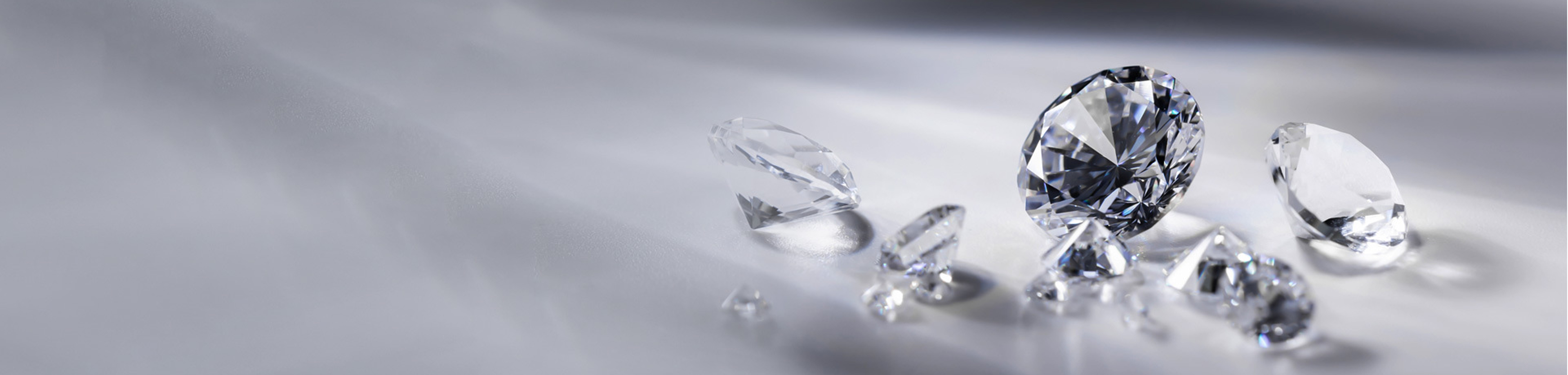
Diamonds with pure colors are colorless and transparent, but they are relatively rare. Most diamond crystals exhibit different colors, with yellow, light yellow, green, light green, brown, and light brown being the most common, followed by orange, black, etc. Red and blue diamonds are relatively rare.
gloss
Based on the intensity of the luster of diamond, it can be divided into three types: strong, medium, and weak.
Light transmittance, refractive index
Diamonds have high light transmittance and refractive index. When they are ground into fine particles, they can reflect more light, making them appear brighter. The high dispersion also gives diamonds a "lustrous" appearance, as white light is specifically dispersed into monochromatic light by diamonds. The dispersion value of diamonds is relatively high among natural gemstones. Theoretical analysis shows that pure diamonds should be colorless. They can penetrate light of various wavelengths, including infrared and ultraviolet rays. This is because the energy required to excite electrons in diamond crystals from the ground state to the first excited state is much higher than that of visible light (1.77-3.10 electron volts).
transparency
Transparency is one of the important indicators for measuring the quality of diamonds. Pure diamonds are as transparent as water. Depending on the trace elements and impurity elements contained in the diamond crystal, the transparency of diamonds is divided into three categories: transparent, translucent, and opaque.
Electrical, magnetic, and thermal properties
electrical property
Generally speaking, diamond is a poor conductor of electricity. The electrical properties of diamond are primarily characterized by its dopability. With appropriate doping, diamond can acquire the characteristics of semiconductor materials. Compared to semiconductor materials such as silicon and germanium, diamond exhibits significantly higher electrochemical performance and Johnson valence number.
magnetism
Diamond is a mineral that does not possess magnetism. However, some diamond crystals exhibit magnetism due to the presence of magnetic inclusions such as magnetite and ilmenite.
thermal conductivity
Under normal temperature conditions, the thermal conductivity of diamond is among the best known. The thermal conductivity of CVD diamond ranges from 1000 to 2000 W/m·k, which is higher than that of natural diamond and six times higher than that of copper, and 13 to 26 times that of cemented carbide.
heat resistance
Diamond is chemically very stable and can withstand non-oxidizing acids at any high temperature, but it cannot resist strong alkalis, oxoacids, and molten metals. It undergoes oxidation under pure oxygen conditions at 720~800°C, and a thin graphitized layer forms under vacuum conditions at 800~1700°C. Under the protection of nitrogen and hydrogen, it remains unoxidized even at 1000°C.