
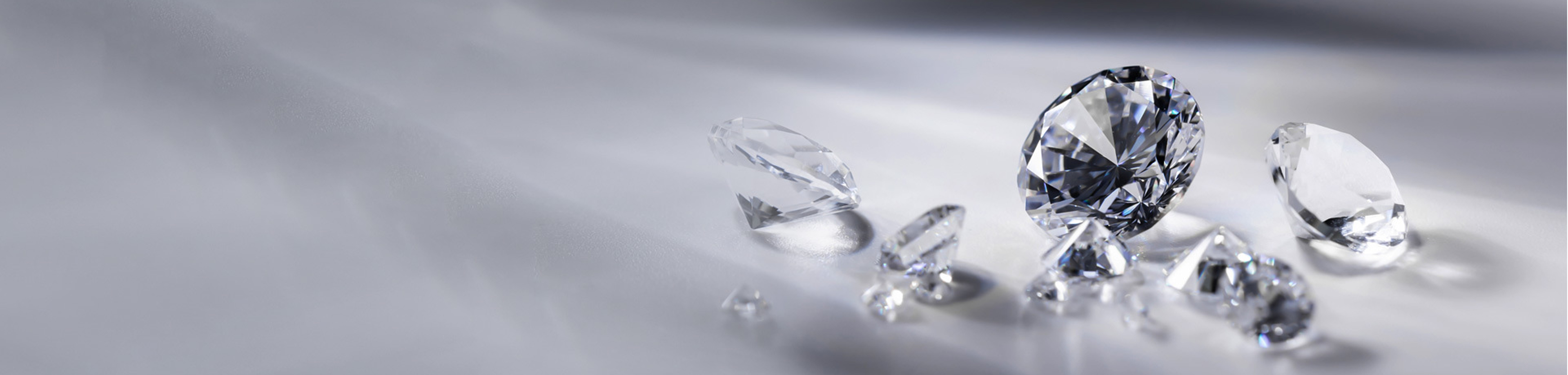
Where do diamonds come from
The research on the formation principles and mechanisms of diamonds primarily relies on studying internal inclusions and conducting artificial simulations of high-temperature and high-pressure experiments.
My parent rocks (host rocks) primarily consist of kimberlite and lamprophyre, which were discovered in 1866 (Kimberley, South Africa) and 1979 (Argyle, Australia), respectively. In other parent rocks such as garnet-pyroxene-mica gneiss or schist, as well as meteoric pyroxenite, a small portion of me is also produced as an inclusion, but it does not constitute economic benefits and has not been mined or commercially applied.
After studying the primary inclusion minerals from different mines around the world, scientists have discovered that I was born (formed) in an environment with a pressure of 4.5-6.0 GPa (equivalent to a depth of 150-200 km) and a temperature of 1100-1500℃. Currently, most of the mines where I am extracted were primarily formed 3.3 billion years ago and during the periods of 1.2-1.7 billion years ago. (So I have spent a very, very long time alone and unattended.)
In addition to two types of primary deposits, I also have secondary deposits. Diamond-bearing kimberlites or lamproites are exposed at the surface and undergo weathering and fragmentation due to extraterrestrial forces such as wind and rain. Under the scouring of water, the fragmented original rocks, along with diamonds, are carried to riverbeds and even coastal areas, where they are deposited, forming river alluvial deposits and coastal alluvial deposits (i.e., secondary deposits of diamonds).
Representative production place
Currently, there are approximately twenty countries that commercially produce diamonds, with an annual output of about 100-120 million carats, mainly exported by countries such as Australia, South Africa, Botswana, and Congo. The total production in Africa accounts for half of the world's output, making it a target of plunder for some illegal elements and organizations, leading to the tragic incidents of "blood diamonds." (It's also my fault for being too beautiful.)
The diamonds in China primarily originate from Wafangdian in Liaoning, Mengyin in Shandong, and Ruanjiang in Hunan.
The diamonds from Wafangdian in Liaoning Province are of high quality and have a large production volume. They belong to Kimberlite primary deposits, but production has currently been suspended due to certain reasons. Mengyin in Shandong Province also has Kimberlite primary deposits, but its gem-quality diamond content is low. However, it often produces large-grained diamonds, such as the "Changlin Diamond" discovered here. The middle and lower reaches of the Ruanjiang River in Hunan Province are alluvial deposits, with lower diamond grades (the number of carats of diamonds per ton or per hundred tons of mined ore, typically tens of carats per hundred tons) and a wide range of varieties.