
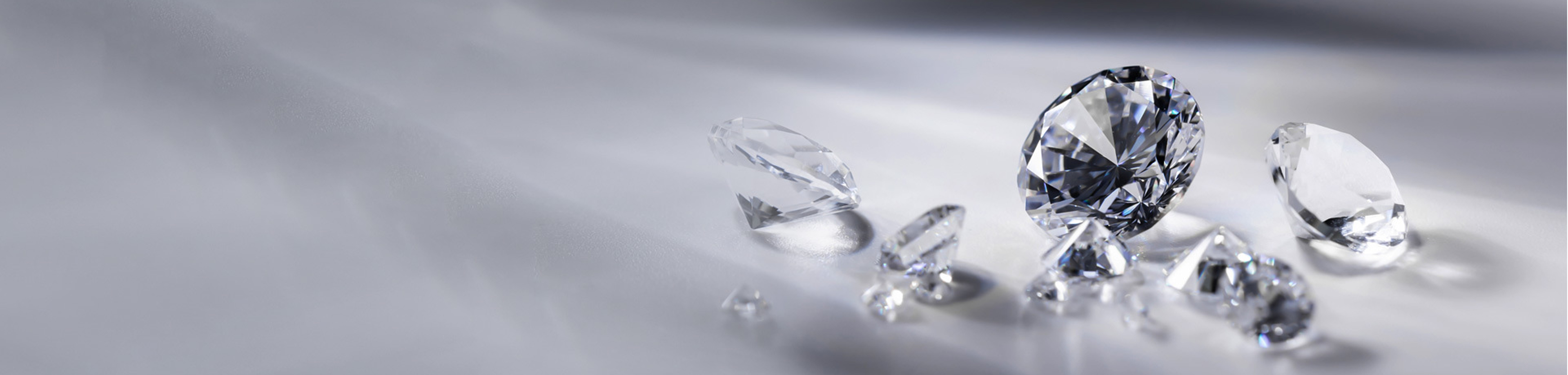
Are diamonds made of diamond?
It's diamond.
Diamonds can be extracted from natural diamond mines or produced artificially. Diamond, commonly known as "diamond", is the original form of the diamond we often refer to. It is a mineral composed of carbon and is an allotrope of carbon. Diamond is one of the harder substances naturally occurring in the world. Diamonds have a wide range of uses, such as crafts and cutting tools in industry. Graphite can be used to form artificial diamonds under high temperature and pressure. Diamonds come in various colors, ranging from colorless to black, with colorless ones being particularly excellent.
The difference between diamond and carborundum
Diamond, also known as a diamond, refers to the unprocessed raw stone, while a diamond is the state of a diamond after being processed. Diamond is a mineral composed of carbon, and only those of higher grades are considered diamonds. Not all diamonds are diamonds; diamonds are the products of selection and processing from among many diamonds. Diamonds can only form under high temperature and pressure conditions deep within the earth, and their scarcity and exquisite beauty make them extremely expensive. Diamond is a relatively hard natural substance, but it can still shatter when struck hard, because it is a highly dense carbon crystal. Diamonds selected from diamonds undergo processing to become expensive jewelry. However, diamonds also have a wide range of uses. They can be used as crafts, and their hardness can be utilized in many industries as cutting tools. Diamond has strong dispersion, which means it can disperse light into colorful patterns. After undergoing fine cutting, polishing, and other processes, diamonds can have more refractive surfaces, and the refraction of light becomes more intense. Therefore, we find that even a small diamond can emit an extremely dazzling light, all thanks to this characteristic.
What is diamond
Diamond primary deposits are only found in kimberlite pipes or a few lamprophyres. Kimberlite and other rocks are their parent rocks, while diamonds in other places are transported by rivers, glaciers, etc. Diamonds are generally granular. Diamond deposits have been found all over the world. Among them, Australia, Congo, Russia, Botswana, and South Africa are the five famous diamond producing countries. China also has the technology to manufacture diamonds, but the largest ones are only about 0.2 carats. There are mainly two methods for synthesizing diamonds: high-temperature high-pressure method and chemical vapor deposition method. The high-temperature high-pressure method is very mature and has formed an industry. Domestic production is relatively high, ranking among the top in the world.
Where does diamond come from
There are two types of diamonds: natural diamonds and synthetic diamonds. For natural diamonds, as we can infer from the introduction above, in order to form a diamond structure, carbon atoms need to be "squeezed tightly". Obviously, this requires great pressure, and in addition, sufficient energy is needed to reconstruct the carbon atoms. Therefore, natural diamonds are often formed under high temperature and high pressure conditions. To achieve such conditions, most diamonds are formed at depths of 150-250 kilometers underground, with a formation time of about 1 billion to 3.5 billion years. This shows the preciousness of diamonds. About several hundred million years ago, they were brought to the surface through volcanic eruptions, so humans have the opportunity to mine them. Currently, there are two methods for synthesizing synthetic diamonds: one is to simulate nature by synthesizing under high temperature and high pressure, and the other is to use chemical vapor deposition for synthesis. Both methods of synthesizing diamonds are mainly used in industry, such as cutting tools, diamond coatings (wear-resistant and corrosion-resistant), as polishing powder, etc. Current technology is still difficult to synthesize continuous, integral, commercial diamonds with gemstone value like natural diamonds in the short term.